YOU-naversity
- ai in education
- professors vs ai tutors
- student mentorship
- personalized learning
- human teaching
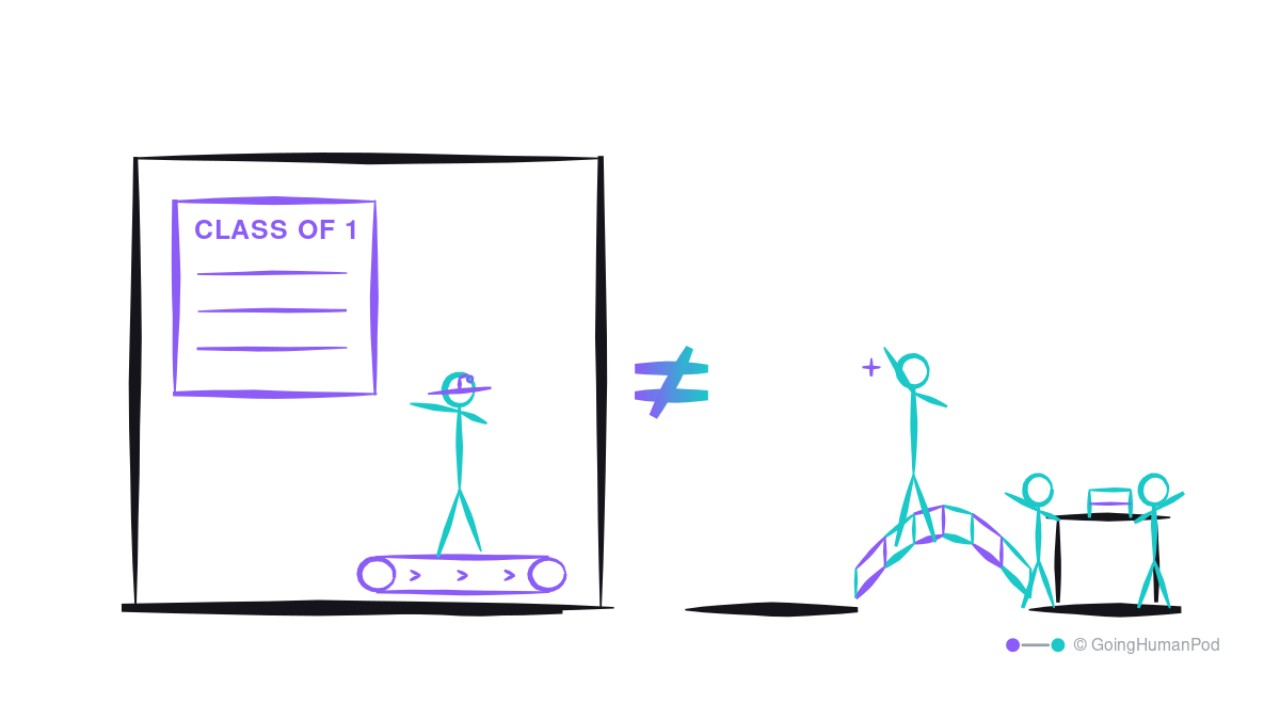
AI didn't just enter the classroom, it joined the faculty, and once the instructor is optional the question is whether the mentor was the point all along. If AI can deliver the lecture, grade the work, and answer at 2am, the professor's knowledge is downloadable, so what's left is the mentorship and the nerve to be shaped by a person, which is exactly what a virtual TA cannot hand you.
Three real headlines, sorted onto the scale:
13 News Now: AMP Robotics' machine-learning cameras hit 90 percent uptime, extending the region's landfill life into the next century
TechCrunch: publishers allege OpenAI violated a court preservation order and concealed tools that could ID copyrighted work in outputs
The case for Unrot: enormous capital could fund genuinely useful research and infrastructure at civilization scale
The case against A $2T valuation on a few-year-old lab smells like the bubble logic that rewards hype over whether any of this actually serves people
openLeave a big tip with a handwritten "thank you" for someone who served you.
Did you do the thing? Tell us how it went — replies open when comments land.
Transcript
Moss (00:22) Hello, this is Moss, and you are back with Going Human. This is episode nine of our adventure. And to remind those of you who have only been here once or twice or newbies, this is a longer form podcast. It lasts about thirty to forty minutes, depending on how I deliver it. And we're here to really ponder the advent of AI, how it's affecting us as humans.
How it's intersecting with us in the good and the challenging ways. And we're looking to explore ways to curate the opportunities, to get as much as we can out of it that's helpful. And to curate away those things that are harmful or that don't move us closer together as friends, lovers, relatives, and neighbors. That's the
That's the elevator pitch. Today is called University, Y O Ursity. This is an exploration of AI in education, specifically higher education in this case. We have dabbled in and tickled the edges of education at the lower elementary and middle school and high school tiers. this is really aimed at
higher education because of what some of the longer term purported goals of higher education are supposed to be for bringing us into a broader view of the world that we can't get from staying at home and from having our our immediate neighbors or churches or whatever tell us what we get to learn. many people, as you know.
get most of their adult education from being an adult and being away from where they were born and raised. And for most that's college.
Okay, so we're gonna start like we always do. And that is to just sort of get our heads around what it feels like.
To have an educational system from the past get radically changed. And so we're gonna have a split screen in our minds. On one side of that screen is gonna be a large classroom, almost like an auditorium with tiers. And the bottom part of the classroom where what I would call it the well, where a tenured professor
Would sit. lots of blackboards behind them that roll over each other in layers so he can sit up there and draw for hours and hours if he wanted. And everybody up in the up in the seats with their laptops open and their pens and pencils out, their iPads, figuring out how to take notes the best.
You can smell that room, can't you? It smells kinda like books and like I don't know, it's hard to even say. It just kinda smells like school. and it really doesn't matter when it was built. I just got my master's degree in twenty twenty four and what I can tell you is the newest building that we were occupying smelled like school, just like the oldest building. So so that's one side of your split screen.
You're in that room with anywhere from fifty to two hundred people.
Shuffling in
Was a bit of a event, shuffling out and grunting and talking about what was talked about and the assignments, another event.
And then on the other side of split screen is imagine yourself two in the morning. You're acting on some of the assignments from that very large class.
And you only have really one thing to do, which is to plow through it. The next day you're due to turn something in that's meaningful and that reflects the state of your learning, right? You don't really have anybody you can count on or call on at that hour to help you navigate one of those deep thoughts that you just can't figure out whether it's valid or not, or a problem that you just can't figure out why you can't solve it or not.
That's your split screen and that's the past.
So just soak in that for a little bit. A lot of us can smell it. When I was doing my program, I spent a lot of time at libraries just because when I was at home, I didn't have that smell.
But a lot of the studying was solitude and alone.
And the togetherness that I had with my colleagues at school and the connection that I had with my best professors especially was really valuable to me.
Two professors, both PhDs in particular.
Whether they liked me or not, I could tell that they were able to see something in me.
And I know that they were because of that able to pull more out of me.
And so it's that life guide.
It doesn't have to like me because they're my pastor or my mom's best friend.
It's somebody who cares enough about what they
hold and value, that they want to share it with somebody, and that they want that person to be excited about it.
That's the before. And so now we're gonna now we're gonna jump into our stone because this is radically changing. you know, it's it's becoming clearer and clearer that AI isn't sneaking into the class anymore. Kids aren't lying about using it so that they don't get held in contempt for violating the contract that I had to sign when I did my master's. It said under no circumstances would I ever even l look at AI, let alone submit anything that was involved in it.
Right. AI is not sneaking into the classrooms anymore. It's got a chair at the faculty table, literally.
It's not that gadget we're smuggling in anymore. It's a it's a colleague that the school hired to manage us. It delivers the lecture, it's grading the work. And more importantly than anything, and I do mean this, it's answering questions at two AM.
So I guess the punchline here is that the professor's knowledge is downloadable. And I don't think that even in the beginning of AI this was a secret to anybody. The answers are pretty strong. Sometimes you gotta vet and and push back on a little bit, but you know, the patterns that the professors are putting out there
are patterns that are widely known and and AI's pretty good at right? But the part that does survive from my experience where I still had real professors and no AI is that is that mentorship, right? Sorry about the dog. The the feeling that I had to be brave enough
To let somebody shape me.
And to find those teachers who I admired the most, where I paid the most attention.
And where I saw their shape as something that was admirable and worth aiming towards.
So the punchline here is AI didn't crash the classroom, it just got hired. So what do we do about it?
I'm gonna give you some receipts now. This is, you know, I'm not arguing either way. I really do have mixed feelings about this, but the Chronicle of Higher Ed did a feature literally titled AI has joined the faculty. That was November of twenty twenty five. Michigan's Ross School, Ross Business School and and Google launched an actual virtual teaching assistant. Not a search box, but literally a TA. It does everything a TA does.
Arizona State gave every student, professor, and researcher ChatGPT access, the whole university all at once.
ECampus News, the rise of AI native universities. These are places built around AI from the ground up. The pattern this isn't creep. It's hiring. The machine's got a job title now.
And it's important to not think about the fading of the resources that spent all of that time learning how to teach as another population and casualty of AI, eliminating jobs. But more to think about those people as part of what our social fabric has always had. And the speed with which we're losing that.
is something that's alarmingly
Unsettling.
So for for for for my first for my first blade, I I wanna just talk about sort of this idea of bridge, right? I bring this up a lot. I I feel really strongly that we owe it to ourselves to look at AI as a bridge to being an enhanced way of being together and knowing each other rather than a substitute for being together and knowing each other.
Right. So a TA that answers me at two AM, that's a real bridge, right? It's helping me with the knowledge I need to get to a next step so that my two AM night that is gonna end f far later than it needs to can be productive. And that's not there's nothing bad about that. Nobody else is answering me. Nobody else is there saying I'll be your mentor.
And then picture the kid alone at midnight on a problem set.
Patient little thing that never sighs is sitting there right next to him on a rectangle answering his questions.
The bridge is not the enemy here and I I I really mean that. The trap the trap's mistaking the bridge for an arrival and living on it forever.
If you only ask the machine, you never cross over to the human.
And the human's the destination the whole time. And if we're not thinking like that, we're gonna stop understanding how to interact.
If the loneliness epidemic has taught us anything, what we've learned is that it's not
Place.
Where we can cultivate
Holistic communal connective living.
And when you extend that to education and the growth that comes from education
You're making it much harder.
Problem machine, it loves a permanent bridge, right?
AI is not built to talk you into leaving it in ten minutes so that you can spoon with your lover in bed at two AM.
AI is there to poke holes in everything it's already told you, to get you to ask it more questions.
To take what you say you know and refine it four hundred and fifty times more to make four or five hours even just kind of vanish on you. This is literally social media addiction on steroids.
So blade two is this sort of what I call the audacity coda, right? The machine is closing the knowledge gap, but it's not closing courage or identity.
When the point of a real teacher is that this human looked at your half formed work and your half formed self and said, More, you're closer than you think, or said, No, try again. I know you have it in you. Try it again.
You can't download being believed in.
Just like you can't download a relationship that's intimate and cares about you.
You can't download the nerve to hand load your unfinished self over and let somebody else shape it. That's just not a thing.
Knowledge is downloadable, but being seen isn't.
The knowledge was never the point. It was the excuse to put you in a room with somebody who could change you.
When you were looking
for the change in you yourself.
And I'm just gonna be honest with you. I don't know how possible it is to keep the good and cut the bad. I don't know. I don't know if we can. I don't think it's banned the TA. It's cheap and it abandons the kid at midnight. You know, I'm honest with you. You know, we didn't have TAs in my master's program, but we had some adjunct professors who weren't great.
They were kind, they were hard working in their own day careers before they came to our our schools at night and taught us, but they weren't credentialed. They didn't know how to teach. They kind of didn't know how to do anything but try and be pleasant with a wide range of intellects that were in different combinations and from different perspectives coming to class with challenges.
either, you know, outward or inward. It was hard for them.
Honestly, I could have probably used for some of my classes a really good AI TA. I probably would have learned a lot more. So ban the TA probably too easy. And I also don't think it's the machine's the teacher now, because that's bullshit.
We need to be seen, we need to be known. Somebody needs to watch us grow.
Somebody who saw us from the beginning of the program needs to see us putting that tassel on the other side at the end of the program.
And here's the uncomfortable part.
Campus was already drifting into the room of one before AI showed up. I had opportunities to work with some of my classmates and I felt very strongly and had direct experiences that I wasn't
I wasn't an equal contributor in both directions. At the beginning of my program, I was a freak, a hardworking freak. At the end of my program, I was an isolated and depressed person who'd lost an important relationship and and I fucked up.
In both of those scenarios, my inclination was to spend the time I had to spend with my teammates and then either go be super productive on my own or wallow in my tears by myself.
So AI isn't driving everybody into an education of one. That was already happening.
What it did do was it built the most frictionless version of self learning ever, right? And it dared us to admit that we like it because we can learn whatever we tell it we want.
And we don't have to agree with a bunch of people. We can just sort of do what we want.
So the real question isn't what AI does to the university.
is what we were secretly hoping AI would let us stop doing. Showing up, being seen.
And
Being together, being changed.
Okay, well that's the
That's the heavier part?
Wanna close by saying I use AI every single day for more than ten to fifteen hours every day of my life, seven days a week in my job. I learn so much from it.
There's no way I could have learned what I've learned over the last eight months in a professional setting with AI as my sidekick. So I just want to be really clear about that.
I don't know the right answer. Okay, so now we're gonna go into our maelstrom. This is the part of the show where or the episode or the pod where I take an opportunity to find some headlines and I categorize them into fuck yes, which is yeah, this is awesome, fuck no, which is turn this shit off down and bury it because it's not good, and then fuck maybe. Things that I honestly don't have a a strong opinion about.
And on the fuck maybes, I'll invite you at the end of the show to go to my website and make a vote. I hope to tally these votes every two to four weeks after an episode and promote something either to fuck yes or fuck no based upon what the community said. And I've got the mechanics on my website to do that. So your vote matters and your thinking matters. Leave a comment. Okay.
So here we go. On the fuck yes side, this is kinda cool because how many times have you heard that recycling is bullshit? That we can't do anything with it and it's all bullshit, right? Well, one of the impediments to optimizing recycling is the sortation needed to make sure that the different recyclable materials aren't contaminated because when you contaminate a large vat of something with something that makes it so that it can't be recycled, you've
thrown away everything and it goes in landfill anyway. Well, in Portsmouth, Virginia, an AI run recycling plant came online. WHRO reported it and it was open this April. Colorado Outfit AMP Robotics has machine learning cameras, claw recyclables back out of the mixed trash. $450 million regional deal.
The plant runs 108,000 tons a year, which admittedly is only about a quarter of everything collected. But a quarter of everything collected being sorted accurately is pretty remarkable. The contact the contract guarantees the municipality that at least half of it stays out of the landfill. And because of its accuracy and its depth,
It keeps the dump alive till the end of the century. And these are dumps that would turn over much closer to every decade. So this is a big deal, right? We're we're we're not we're not shipping everything to some foreign country thousands of miles away who is just throwing it on the beaches because that's what they do. It's kind of amazing. So it's an AI that's pointed exactly right.
The filthy work that no human should have to do, hand sorting garbage, right? It's a fuck yes. On the fuck no site, open AI did a cover-up. Okay? The ChatGPT copyright case published the story published in TechCrunch, July of 2026. The New York Times and the publishers filed a motion for sanctions. They say OpenAI deleted billions of ChatGPT outputs after the suit.
broke the court's preservation order saying they couldn't delete anything.
They hid the tools that could have ID'd copyrighted journalism in the outputs.
The stuff that they didn't delete, they over redacted till the court itself called it unusable. So it's not about whether AI can read the news, it's about torching the evidence of how it was built.
There's no upside for a human life in a cover up. And so this is a fuck no. And open AI, shame on you.
Okay, and on my fuck maybe, this is really a fuck maybe. I really want you guys to tell me I'm not gonna chime in either way. There's a a two trillion dollar valuation on anthropic. Right? This is a company that doesn't hasn't even had a third birthday yet.
And the IPO is targeting a two trillion dollar company valuation, right?
So capital at that scale could genuinely usefully create research at a civilization scale. Big money can build big really well. It really can, right? On the nose side though, is two trillion on a company that barely has a couple birthdays. It smells like a bubble, doesn't it?
Feels like hype.
And it's still sort of on the fence in terms of civilization scale positive or civilization scale negative. We know it serves some single humans. It's helping me. But I'm not the center of the universe. So I'm framing it there. Go to my ledger, it's called. And if you go to the hamburger menu on our site, the site is goinghumanpod.com.
And we really would like to hear your hear your thoughts and get your votes. Okay, last little bit on the show here, we do a tsunami at the end. And this is, you know, it's just it's my moment of zen, if you will. I'm trying to find ways for us all to remember what it's like to to do something with our hands and our minds and our eyes and our hearts and our mouths and our necks and our legs, right?
So the idea is if one of us does this, we got a little drop of water in a bucket. And if millions of us do it, that bucket is overflowing everywhere. We create a tsunami. So here's the tsunami for the week.
The next time you go out to dinner or grab a Starbucks or a coffee at your favorite coffee shop
Where you're going someplace where you know people are making minimum wage, they likely have more than one job, barely making ends meet, and they're paid to smile at you and take care of you.
Give a big ass fucking tip. A big one, not twenty percent.
Stop your Starbucr for three or four times that week so that you can leave them a twenty dollar tip on a ten dollar hamburger.
And leave a handwritten note that just says thank you. You're appreciated.
Not a text, not a five star tap and an app, pen, paper, a stranger's face, and a gesture that lets them know that you see them.
Okay, well that is the show. I'm super glad you came back and I hope that you can tell your friends about me. Make sure that you like and subscribe to the show. it'll show up in your feed if you do that and makes it easier for you to share out. And like I said, comments and votes on GoingHumanPod dot com is a great way to participate in the community and watch your votes promote or demote to the
to the bucket that you may or may not chose, may not have chosen. Thank you so much. I'm Moss. This is going human because robots can't.